
New Industry Assistant Professor Aarati Akkapeddi Explores the Human Side of Emerging Technology
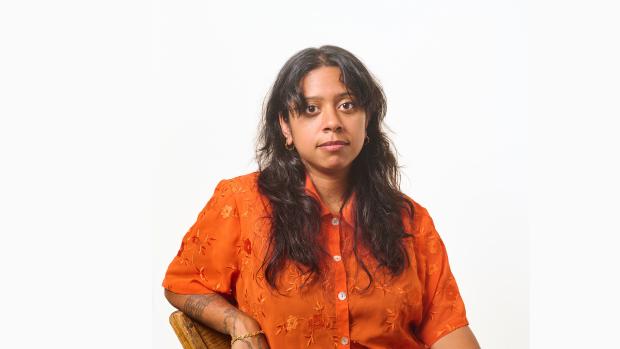
Photo Credit: Max Branigan
For Aarati Akkapeddi, the boundaries between art, design and technology are less like walls than doorways. They move fluidly among the three, using each to ask questions about the others. As an artist, technologist and educator, Akkapeddi has spent much of their career exploring how emerging technologies can be understood not just as tools but as cultural objects with social, ethical and political consequences.
Now joining NYU Tandon, Akkapeddi brings that interdisciplinary approach to the Integrated Design & Media program, where they will continue developing creative and critical approaches to technology.
Akkapeddi grew up in upstate New York and studied industrial design as an undergraduate. They had been an artist for as long as they could remember, but design offered a way to apply creative skills to functional problems. Their education also introduced them to research methods that would later become central to their artistic practice.
While studying design, Akkapeddi became interested in coding and eventually began working as a web developer and designer, a career they have pursued for more than a decade alongside their artistic work. Over time, the connections among design, programming and art became increasingly important to their practice.
Today, Akkapeddi might combine printmaking with coding, or machine learning with bookmaking. Their artistic projects often incorporate techniques associated with design research, including interviews, prototyping and site visits. For Akkapeddi, these approaches provide ways to investigate questions that might otherwise remain abstract.
One project, “I Knew That If I Walked In Your Footsteps, It’d Become a Ritual,” grew out of their interest in memory, including intergenerational memory and their experience as a first-generation American. A close family member’s memory loss also shaped the work.
Akkapeddi trained a machine-learning model on family photographs and used the resulting images to explore memory as a process of approximation. The generated images resemble the family photographs but also diverge from them. The project includes a video featuring interviews with family members about photography and memory.
The process of creating the work led Akkapeddi to a larger set of questions about how artificial intelligence systems are built. They began thinking about where datasets come from, whose labor goes into creating and processing them, and what it means to build a model using data collected with care and intention.
That exploration has evolved into what Akkapeddi calls “handmade datasets,” a pedagogical practice inspired by J.R. Carpenter’s A Handmade Web that they have developed into educational courses. Students work with small datasets they collect themselves, using them to learn the technical foundations of machine learning while also examining the much larger systems behind contemporary AI.
The approach opens the door to questions about labor, data collection, energy consumption and the ethics of large-scale AI systems.
At Tandon, Akkapeddi sees an especially good fit for this kind of work. They appreciate the program’s willingness to move between disciplines and to place technological tools within broader cultural and social contexts.
“For me, it’s extremely important that we don’t teach tools and methods in a vacuum,” they said. “Always contextualize these things culturally, socially, ethically, creatively.”
Akkapeddi is also interested in “digital divination,” an ongoing pedagogical practice developed with collaborator Erica Kermani. The project challenges how (if you want you can just say ‘dominant’ instead of western and capitalist) Western and capitalist hegemonies have shaped technology to serve systems of oppression and extraction. Instead, it draws from sacred practices of the Global Majority to speculate on harmonious relationships between humans, non-humans, and machines.
Their interest in community extends beyond the classroom. Akkapeddi has lived in Brooklyn since 2010 and remains involved in local creative communities, including the Center for Book Arts and the School for Poetic Computation. Akkapeddi has already spent time at NYU, having been a project fellow at the Interactive Telecommunications Program in 2021. Returning to the university, they see an opportunity to work alongside artists, designers and technologists who share their interest in crossing boundaries.