

New Chemical and Biomolecular Engineering Chair LaShanda Korley Bridges Polymer Science with Sustainability
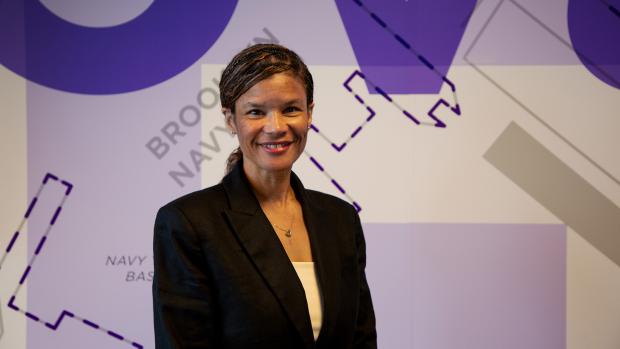
NYU Tandon has named LaShanda Korley, an internationally recognized leader in sustainable materials, plastics waste valorization, and bio-inspired engineering, as the new chair of its Department of Chemical and Biomolecular Engineering. An accomplished polymer scientist whose work addresses pressing challenges in manufacturing, plastics waste, and sustainability, Korley brings a track record of pioneering research, center leadership, and interdisciplinary collaboration.
Korley has built a career at the intersection of chemistry, engineering, and biology, using molecular design to address pressing global engineering challenges. She joins NYU from the University of Delaware, where she leads the Center for Plastics Innovation and has advanced new approaches to designing performance advantages from renewable resources while developing technologies to make plastics more circular and environmentally sustainable.
Korley began her chemical engineering journey as a dual-degree student between Clark Atlanta University and Georgia Institute of Technology. Her fascination with polymers emerged during a pivotal undergraduate research experience at Virginia Tech where she worked with one of the first academic atomic force microscopes and witnessed the materials she had created at the nanoscale. “To see the materials that I created come to life at that scale was a defining moment of realization that I can really link chemistry, structure, and properties, and that's what I built my career on,” Korley says.
Korley went on to earn a Ph.D. in chemical engineering with a concentration in polymer science and technology from MIT, followed by postdoctoral research at Cornell University. She launched her independent career at Case Western Reserve University’s Department of Macromolecular Science and Engineering. During her time there, she also launched the NSF-funded PIRE: Bio-Inspired Materials and Systems center, which linked a diverse group of researchers across disciplines and international borders with the goal of developing functional, programmable, and responsive materials for deployment in soft robotic systems.
At the University of Delaware, her research program evolved to focus on plastics sustainability. She studies how renewable resources such as lignin and citric acid can serve as building blocks for new materials that match or exceed current performance requirements, while also ensuring a secure supply chain and leveraging non-food source competing waste streams.
At the same time, her group re-imagines plastics waste as a valuable product. Through a polymer science and engineering lens, her team seeks new ways to break down discarded plastics, recover valuable components, and design materials that are inherently easier to recycle. This work forms the basis of the Center for Plastics Innovation, an Energy Frontier Research Center funded by the Department of Energy, which she will continue to lead from New York City.
Nature remains a central source of inspiration for Korley’s scientific thinking. Among her favorite examples is spider silk, a material she describes as one of nature’s most remarkable engineering achievements. By studying how biological materials evolve to perform specific functions, she aims to uncover principles that can be applied to technologies such as adaptive sensors, advanced fibers, and responsive materials.
Korley is a Fellow of the American Institute of Chemical Engineers, the American Chemical Society, and the Royal Society of Chemistry, among other honors. In 2023 she was appointed as a U.S. Science Envoy by the U.S. Department of State, where eminent scientists identify and foster international collaborations to tackle pressing challenges.
Beyond her scientific accomplishments, Korley is a collaborative leader who sees innovation as a collective endeavor. She is particularly excited by opportunities to bring together researchers across disciplines to address complex societal challenges in sustainability, health, and engineering. She believes the future of chemical engineering depends on balancing strong disciplinary foundations with increasingly interdisciplinary approaches to research and education. “At my core, I really enjoy bringing people together to do new, exciting, and impactful activities. What I enjoy is empowering the research by empowering the people,” she says.