
From Comets to Climate Models, New Professor Alistair Adcroft Wants to Bring Ocean Science Down to Earth
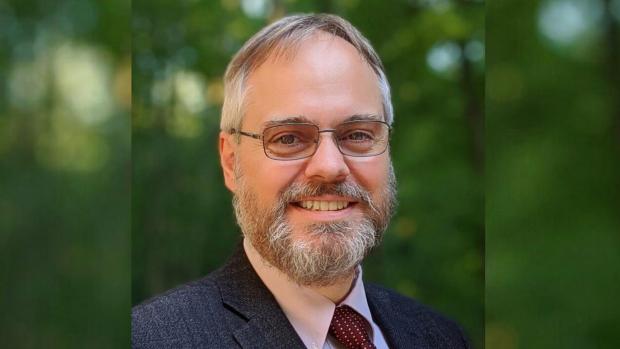
As a child, Alistair Adcroft was fascinated by space. When he began studying physics at Imperial College London, he assumed he was on his way to becoming a cosmologist. Instead, a chance encounter with a numerical methods course sent his career in an entirely different direction.
Adcroft, who is joining NYU Tandon as a professor of Professor of Chemical and Biomolecular Engineering and Earth System Science and Engineering, became interested in the problem of representing the physical world on a computer. At Imperial, he had been working on a project modeling the tail of a comet when he encountered researchers using similar mathematical and computational techniques to study the Earth.
“I thought I was going off in one direction,” he recalls, “and just by pure chance, I happened to be going to some lectures and ended up doing a right turn.”
That turn led him to ocean and climate modeling, where he has spent much of his career developing numerical methods for understanding one of the planet’s most complex physical systems.
The basic challenge sounds straightforward: build a computer model that behaves like the real ocean. In practice, it is anything but.
“The ocean turns out to be a really big system,” Adcroft says. And he means big not simply in geographic extent, but in the range of scales that have to be represented. Atmospheric weather systems such as cyclones can span hundreds to thousands of kilometers. Their ocean counterparts, known as mesoscale eddies, can be just tens of kilometers across. A single ocean basin can contain hundreds or thousands of them.
The ocean also operates on much longer timescales. Weather systems can evolve over days or weeks, while the ocean can take centuries or longer to approach equilibrium.
“We have a bigger problem in space, and it's a bigger problem in time that we have to solve,” Adcroft says.
As a result, even the most sophisticated climate models cannot explicitly represent everything happening in the ocean. Researchers must decide which processes are important enough to include and which can be approximated. This is known as the “closure problem,” a fundamental challenge in fluid dynamics.
For Adcroft, solving that problem requires understanding what the ocean ought to be doing physically, then designing mathematical methods that reproduce those behaviors as faithfully as possible.
“How do you best represent what the real world, the continuous real world, is actually doing?” he says. “Is what my model is doing physical or unphysical?”
That question has taken Adcroft’s work well beyond abstract numerical mathematics. His research has examined ocean circulation, icebergs, tsunami, sea ice and the movement of pollutants through the ocean. One particularly consequential episode came after the 2010 Deepwater Horizon oil spill in the Gulf of Mexico.
Existing oil-spill models were primarily designed for spills occurring at or near the surface. The Deepwater Horizon disaster was different: enormous quantities of oil were released deep below the ocean surface. Adcroft’s group joined researchers at NOAA’s Office of Response and Restoration to rapidly adapt ocean models to the new problem.
Within weeks, their simulations suggested that some of the alarming predictions circulating at the time, including the possibility that the oil could spread across the North Atlantic, were wrong.
“It was a very eye-opening experience,” Adcroft says. “I realized that what you see in the headlines isn't necessarily complete, even though they have experts being quoted by those headlines, sometimes even those experts can be working with outdated information.”
The experience also underscored the value of connecting different kinds of expertise, an approach Adcroft hopes to bring to Tandon.
Climate science, he says, increasingly has to move beyond questions about whether climate change is happening and toward questions about what it means for people and what can be done about it.
“We know climate change is happening. We also know why,” he says. “But that's kind of secondary to the big question now, which is: So what do we do about it? What can we do about it? And what does it mean for you and me?”
At Tandon, Adcroft sees an opportunity to connect large-scale climate models with engineers working on problems at the local scale, including flooding, wildfire and urban resilience. Rather than confining his work to a single department, he wants to build collaborations across disciplines and scales.
“I've got the climate scale model data and we’ll bring it down to the engineering scale,” he says. “So that's basically the idea.”
That interdisciplinary approach will extend to his work with machine learning. Adcroft has been involved in applying machine learning to climate modeling for several years, including efforts to use data-driven methods to represent processes that conventional models cannot resolve.
The results, he says, have been striking. Machine learning has helped researchers build better parameterizations of unresolved ocean processes, improve sea-ice prediction systems and develop “emulators” that can reproduce the behavior of much more computationally expensive climate models.
But Adcroft is cautious about viewing machine learning as a replacement for conventional models. Machine-learning systems depend on data, and there is an obvious problem when the goal is to predict a climate that has never existed before.
“We don't have data from the future,” he says. “So that's where the models are going to be relied on.”
For Adcroft, the future of climate modeling will therefore involve both approaches: physics-based models that can explore unfamiliar conditions, combined with machine learning that can make those models faster, more flexible and more useful.
It is a fitting evolution for a scientist whose career began by asking how to represent a comet on a computer. The subject has changed from distant celestial bodies to the oceans beneath the waves, but the fundamental question remains remarkably similar: How can mathematics and computation capture the behavior of the real world?
Now, at Tandon, Adcroft hopes to push that question closer to the people who ultimately have to live with the answers.