
The Advancing Prediction Frontier for Chemistry and Materials
Speaker
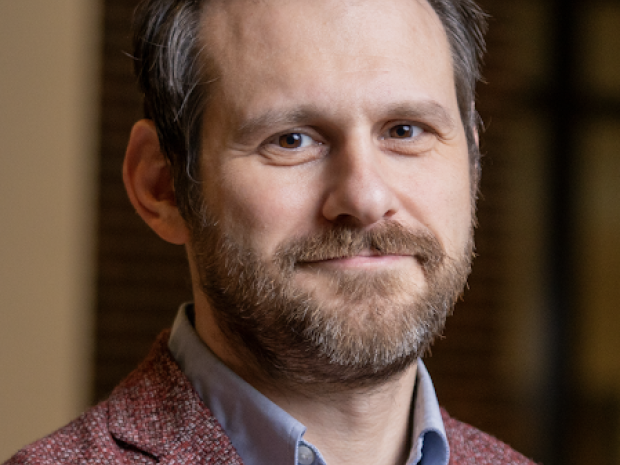
Brett M. Savoie
Coyle Mission Collegiate Professor of Engineering
University of Notre Dame
Abstract
Many areas of chemical and materials modeling have historically been limited by the physical approximations required to reach experimentally relevant time and length scales. But increasingly, AI is enabling many phenomena to be modeled directly, or at least with sufficient accuracy to meaningfully anticipate experiments. This talk will discuss three areas in which our group has made progress over the past two years where purely physics-based approaches previously appeared predictively intractable, while now practical models have been distributed for all three. The first problem is the prediction of multistep reaction sequences. The cost of reaction characterization has fallen dramatically, leading to a range of practical prediction capabilities and contributing to renewed interest in reaction network modeling. The second problem is inverse structure prediction, considered in two forms: inferring chemical structures from analytical spectra and generating structures that satisfy specified properties. The third problem is property imputation for sparse datasets. Aligned datasets containing the same properties for every structure are exceedingly rare, but imputation allows partial property records to support inference on unseen properties. Together, these examples illustrate the rapidly expanding scope of what is plausibly computable in chemical engineering.
Bio
Brett M. Savoie is the Coyle Mission Collegiate Professor of Engineering at the University of Notre Dame, where he directs the Scientific Artificial Intelligence Initiative and serves as a deputy director of the University's Data, AI, and Computing Initiative. Before joining Notre Dame in 2024, he spent seven years on the chemical engineering faculty at Purdue where he was promoted to the Charles Davidson Associate Professor of Engineering. He studied chemistry and physics at Texas A&M, earned his Ph.D. in theoretical chemistry at Northwestern, and completed postdoctoral training at Caltech. His research has been recognized by the NSF CAREER and Office of Naval Research Young Investigator programs, the inaugural Dreyfus Program for Machine Learning in the Chemical Sciences and Engineering, and the 2025 Journal of Physical Chemistry / ACS PHYS Division Lectureship.