

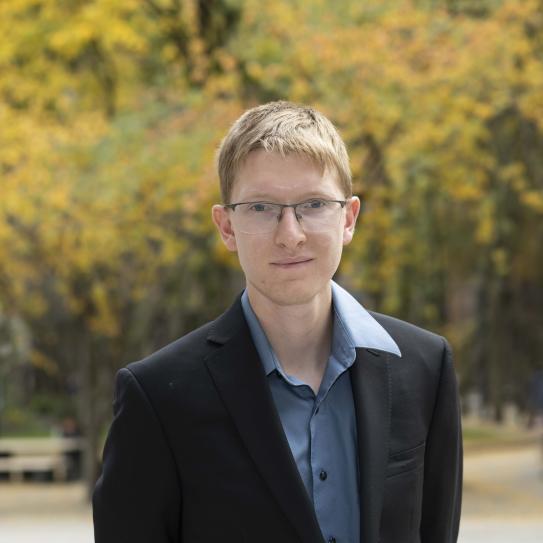
Michael Batavia
UN Sustainability Goals
- Industry, Innovation and Infrastructure
Areas of Excellence
- Data Science/AI/Robotics
- Health
- Urban
Global Challenge: Reverse-Engineer The Brain
Abstract:
In my research, I present a method for helping the blind navigate busy construction sites in urban metropolises like New York City. When streets are being repaired and sidewalks are detoured into alternative pathways, often narrowing the walking passageway for normal pedestrians and often being of different terrain than a standard sidewalk, it can be difficult to blind persons to navigate comfortably and safely without hurting themselves. Construction sites introduce hazards like uneven surfaces, obstructive barriers, hazardous materials, and excessive noise, and they can alter routing, complicating safe mobility.
Existing assistive technologies are limited, as navigation apps do not account for construction sites during trip planning, and detection tools that attempt hazard recognition struggle to address the extreme variability of construction paraphernalia. With the use of object detection software, powered by YOLOv8, optical character recognition, and a depth detection model all rolled into one framework, myself and my colleagues from NYU Langone Health present a way to detect construction sites with a 88.56% accuracy detecting objects from a distance of 2 to 10 meters away with added rotation between 0 and 70 degrees.
With a focus in urban transportation and computer vision / AI systems, this work addresses a key part of my focus to increase urban mobility, especially to those who are disabled and unable to navigate as swiftly as others about their day. It also directly addresses the work going to solve UN Sustainable Development Goal #9: Industry, Innovation and Infrastructure. It is a hazard that modern day trip planning applications do not take into account construction detours or lack of sidewalks when planning walking routes between origin-destination pairs. I’ve risked myself many times walking on road shoulders in suburban neighborhoods in Upstate New York and rural New Jersey in order to find a bus stop or train station to get home due to lack of sidewalks or impromptu detours in protected bikeways and greenways. Not only can normal pedestrians increase their chances for vehicle collisions but blind persons are also at risk for serious injury or even death if they do not mind their step or see a car coming.
By reverse-engineering the human sight system with object detection software, I ensure that all pedestrians can enjoy their walking experience in a walkable city and not have to suffer adverse effects as is the case for many car-centric towns across the United States.
Bio:
Michael Batavia is a Computer Science and Technology Management student from the NYU Tandon School of Engineering and a GLASS honors student from The Bronx, NY engaged in work primarily focusing on UN Sustainable Development Goals #9 and #11: Industry, Innovation and Infrastructure and Sustainable Cities and Communities. During his time at GLASS, he has studied abroad in 5 countries (Spain, Sweden, Vietnam, South Korea and Portugal) and worked on cutting-edge mobility research projects at NYU Langone Health and at the Cornell Nanoscale Facility.
He has also worked with start-ups at the NYU Future Labs, working on integrating new and advanced artificial intelligence and large language model technologies into B2B efficiency products, marketing toolkits and in the construction of new buildings and highrises. During his time abroad, his focus has been on the regulation of AI technologies through AI safety programs and techniques such as through interpretability, inner and outer alignment and chain-of-thought prompting. Contributing to discussions in AI Alignment programs run by Lund University and facilitating research paper reviews with students from all over the world (Munich, Toronto, New York City, Rio De Janeiro, Budapest, Dresden, Stockholm) with the help of Effective Altruism Hungary has solidified his passion for this field and future work and research in post-graduate studies.
By pursuing research in this way through entrepreneurship and research and by working with universities doing research at the cutting-edge and companies building on large language models, he believes that one could explore how to improve automation at its highest level, explore new neural linking structures and deliver new and improved impacts on the field of health informatics. In the medical sector, one might be able to predict cancer before it develops throughout the body with convolutional neural networks and create new drug delivery devices with computer vision and nanotechnology that could not be done before using object detection software.
With his passion, determination and curiosity in biomedicine, nanotechnology, deep learning and in public transportation networks, Michael knows that he can improve the state of infrastructure and innovation one agile step at a time.