

Breaking Pseudoequilibrium States for Enhanced Carbon Recovery in Hydrothermal Biomass-to-Biofuel Conversions
Speaker Details:
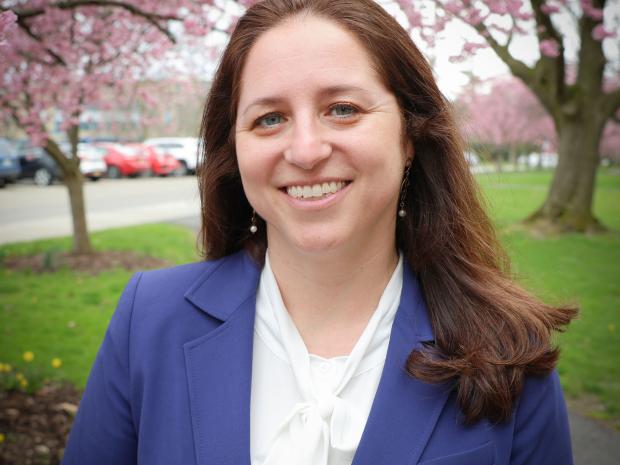
Jillian L. Goldfarb
Assistant Professor of Chemical and Biomolecular Engineering and of Archaeology
Cornell University
Abstract
Hydrothermal liquefaction (HTL) is a promising route for converting wet biomass waste into renewable fuels because it leverages water as both solvent and reaction medium under conditions where its physical properties differ dramatically from those at ambient conditions. Yet, despite water's central role in solubilizing biomass, mediating reactions, and governing product separation, its behavior during HTL remains poorly understood.
To address this challenge, our laboratory developed a novel reactor capable of measuring the dielectric constant in situ under hydrothermal conditions, providing a direct probe of solvent structure and solute-solvent interactions during biomass conversion. Early measurements suggest that reacting biomass-water systems increasingly resemble water itself as conversion proceeds, while the final products do not return to the dielectric properties of pure water upon cooling. These observations point toward the formation of metastable, pseudo-equilibrium states that persist after reaction and may fundamentally influence product recovery and carbon partitioning.
This perspective reframes HTL as the generation and destabilization of a highly concentrated supersaturated solution rather than solely a sequence of chemical reactions. The resulting framework helps explain why substantial quantities of biomass-derived carbon remain trapped in aqueous process streams and suggests new opportunities for carbon recovery. Building on this concept, we demonstrate that salt-assisted liquid-liquid extraction can deliberately disrupt these pseudo-equilibrium states, increasing partitioning of biomass-derived organics by more than an order of magnitude and reducing residual organics in process water to below 200 mg L⁻¹. These results suggest that manipulating solvent structure and phase behavior may be as important as manipulating reaction pathways for improving the efficiency and economics of sustainable fuel production.
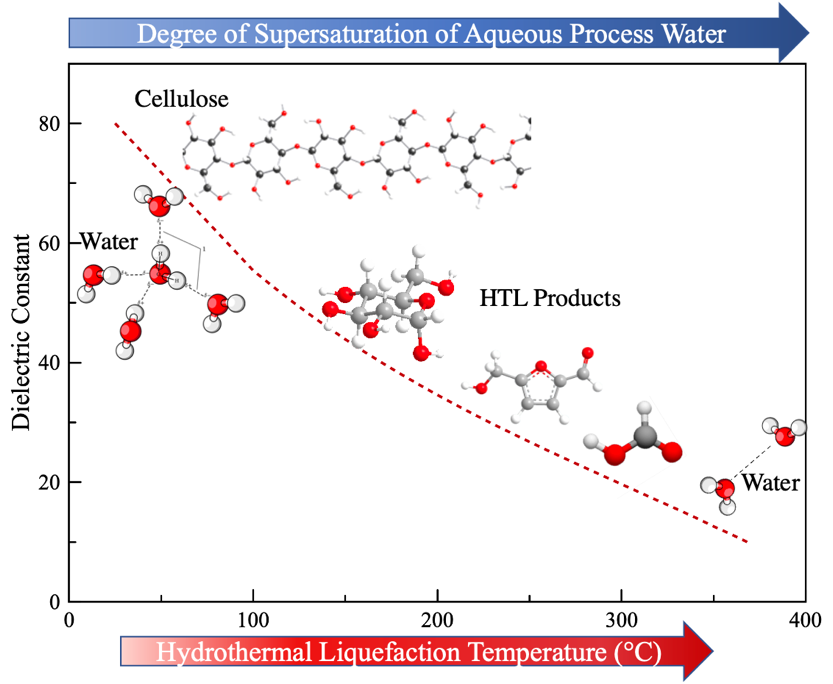
Water’s hydrogen bonding relaxes during hydrothermal liquefaction as it breaks down biomass constituents, which in turn are increasingly soluble due to alignment in solution polarity
Speaker Biography
Prof. Jillian Goldfarb is an Associate Professor of Chemical and Biomolecular Engineering and of Archaeology at Cornell University. An internationally recognized researcher at the intersection of energy, sustainability, and public engagement with science, she has developed innovative approaches for converting solid waste into valuable materials, advanced biorefinery pathways for renewable biofuels, and applied analytical methods from biofuels research to recover organic residues from ancient pottery. Her work on public understanding of science was highlighted by the White House during the COVID-19 pandemic. Beyond her research, Prof. Goldfarb is a leader in STEM education, mentoring, and developing inclusive learning spaces. An expert in engineering educational assessment, she serves as the Duffield College of Engineering Dean's Fellow for Undergraduate Education. Through her LinkedIn presence, she illuminates the hidden curriculum of academia to support graduate student success and strengthen faculty mentoring. She is co-host of the podcast STEMinism Unfiltered, which explores the experiences of women in STEM. Prof. Goldfarb is a recipient of the NSF CAREER Award and ACS Green Chemistry Institute GreenX: Rising Star Award, was a Fulbright Scholar to Italy, and is a Fellow of the American Chemical Society.