

Mechanism of Quiescent Nanoplastic Formation from Semicrystalline Polymers
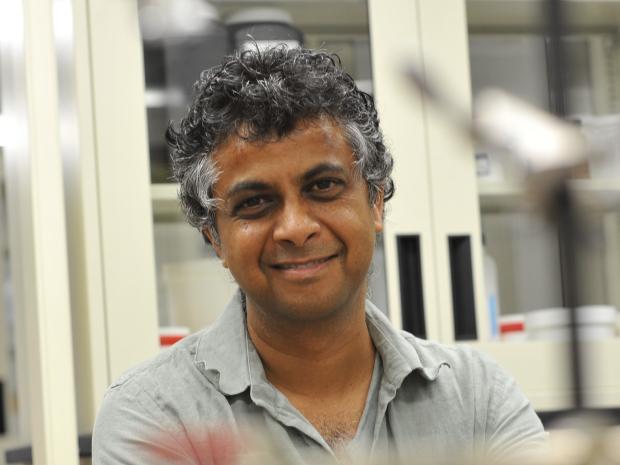
Speaker Details
Sanat K. Kumar
Department of Chemical Engineering
Columbia University
Abstract
Polymers are known to spontaneously produce microplastics (sizes 1 - 3mm) and nanoplastics (10nm - 1). Still, the mechanisms by which environmentally-triggered Å-level random bond breaking events lead to the formation of these relatively large fragments are unclear. Significantly, 70 % of commercial polymers are semicrystalline, with a morphology comprised of alternating crystalline and amorphous layers, each tens of nanometers thick. It is well-accepted that chain scission events accumulate in the amorphous phase. We show that this leads to mechanical failure and the concurrent release of particulate nanoplastics comprised of polydisperse stacks of lamellae even under quiescent conditions. Noncrystalline analogs, which do not have a well-defined microstructure, do not form nanoplastics. While the amorphous phase of the semicrystalline nanoplastics continues to degrade, crystal fragments do not, and hence, they temporally persist in the environment. These results stress the critical role of polymer microstructure and fracture mechanics on particulate nanoplastic creation.
Speaker Biography
Sanat Kumar received his B. S. degree in 1981 from Indian Institute of Technology in Chennai and then a Sc. D. from MIT in 1987, both in Chemical Engineering. After working as a postdoc at IBM Almaden, he joined the faculty at Penn State University (1988 – 2002, Materials Science/Chemical Engineering) then Rensselaer Polytechnic Institute (2002-2006, Chemical Engineering). In 2006, he joined the Chemical Engineering Department of Columbia University, and served as department chair in 2010-16. Prof. Kumar has worked on a variety of problems in a broad range of polymeric and complex fluids systems. His current interests lie in recycling polymers and the creation and mitigation of nanoplastics. For his efforts he has received several honors including visiting Distinguished professorships at various universities abroad, and the Polymer Physics prize of the American Physical Society.