

Generative AI and Diffusion Models: A Statistical Physics Perspective with Giulio Biroli
Abstract
Generative AI represents a groundbreaking development within the broader “Machine Learning Revolution,” significantly influencing technology, science, and society. In this talk, Giulio Biroli, Professor of Theoretical Physics at the Laboratoire de Physique de l’École Normale Supérieure, will examine the fascinating connections between generative AI, particularly diffusion models, and statistical physics.
Diffusion models represent the state of the art in generating images, videos, and sounds. They are particularly fascinating to physicists because of their close connection to concepts in stochastic thermodynamics, especially time-reversed Langevin dynamics. These models begin with a simple white noise input, which evolves through a Langevin process to generate complex outputs such as images, videos, and sounds.
Biroli will demonstrate how statistical physics provides principles and methods for characterizing this generation process. The emergence of features can be understood through the lens of symmetry breaking and dynamical phase transitions, while the emergence of creativity—or its absence, in the form of memorization—can be explained through theories of disordered systems and dynamics in complex energy landscapes.
The talk will conclude with an examination of the fundamental reasons behind the success of diffusion models, highlighting a deep connection between their multiscale generation mechanism and the renormalization group analysis of physical systems.
About the Speaker
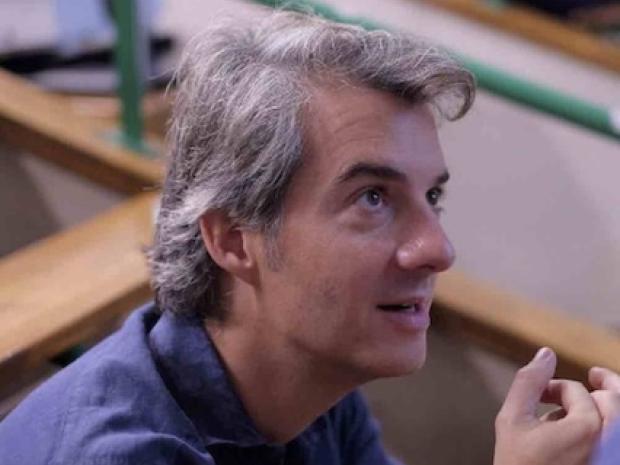
Giulio Biroli is a Professor of Theoretical Physics at the Laboratoire de Physique de l’École Normale Supérieure. His interests lie in a disparate set of topics in theoretical physics and its interdisciplinary applications. A central field of his research is statistical physics of classical and quantum systems, in particular disordered systems. As for interdisciplinary applications, Professor Biroli is currently working on Machine Learning and Theoretical Ecology.