

Somatic Repeat Expansions as a Therapeutic Target for Repeat Expansion Disorders
Speaker
Prof. Ricardo Mouro Pinto
Assistant Professor
Department of Neurology
Harvard Medical School
Abstract
This seminar will explore the emerging role of somatic DNA repeat expansion as a key driver of neurodegeneration in repeat expansion disorders and the potential of targeting this process to delay disease onset and progression. Using Huntington’s disease as the primary model, the talk will cover three major areas: (1) the development of biomarkers to measure somatic repeat instability in accessible patient tissues; (2) the identification of genetic modifiers of repeat expansion, particularly DNA mismatch repair genes, through in vivo CRISPR-Cas9 screening; and (3) the development of precision therapeutics to suppress repeat expansion, including CRISPR base editing of MLH3 to eliminate its endonuclease activity. The presentation will also highlight emerging evidence that suppressing somatic expansion can improve outcomes in other disorders, such as spinocerebellar ataxia type 1, supporting the potential for broadly applicable therapies across repeat expansion diseases.
Dr. Ricardo Mouro Pinto is a Principal Investigator at the Center for Genomic Medicine, Massachusetts General Hospital, and an Assistant Professor of Neurology at Harvard Medical School. He is also an Associate Member of the Broad Institute of MIT and Harvard and an Invited Principal Investigator at the University of Coimbra, Portugal. Dr. Mouro Pinto leads a research program focused on understanding the molecular mechanisms underlying DNA repeat expansion disorders, particularly Huntington’s disease and Friedreich ataxia, and translating these discoveries into novel therapeutic strategies. His work has helped establish DNA mismatch repair genes as key regulators of somatic repeat expansion and potential therapeutic targets. His laboratory combines human genetics, mouse models, and genome engineering technologies to identify genetic modifiers of disease, develop biomarkers of somatic instability, and advance precision therapies using CRISPR-based genome editing. His research has been supported by the NIH, DoD, and several disease-focused foundations, including support through the inaugural Huntington’s Disease Foundation Transformative Research Award. His work was recognized among the NINDS Top 10 Research Advances of 2025.
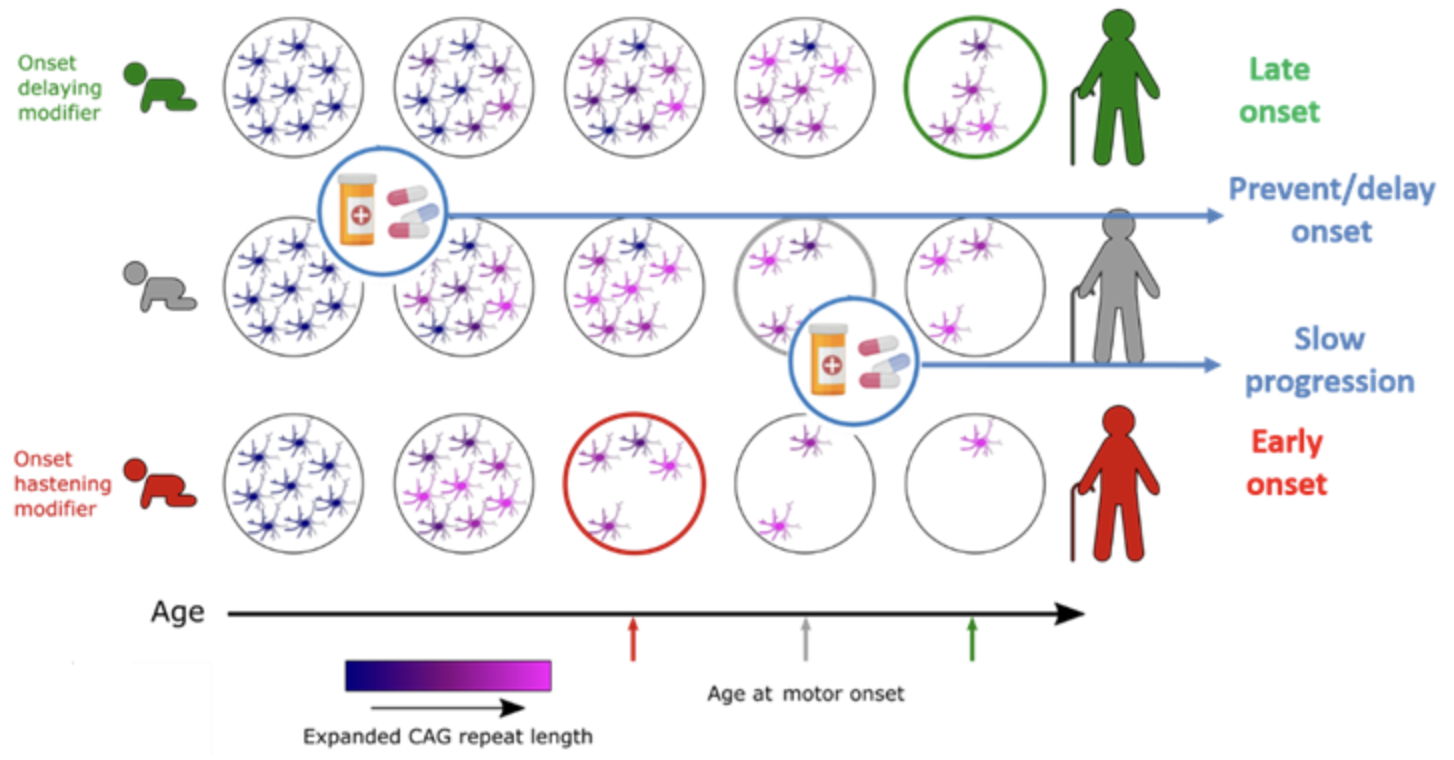
Diagram illustrating how genetic modifiers and therapeutic interventions alter CAG repeat expansion in Huntington's disease, shifting the age of motor onset between early, typical, and late onset.