
Stem-cell derived human corneal organoid model - advances and challenges in its use as a corneal surrogate
Speaker
Prof. Shukti Chakravarti
Professor
Department of Ophthalmology and Department of Pathology,
NYU Grossman School of Medicine
Abstract
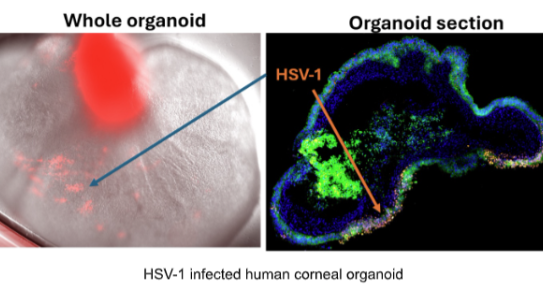
Prof. Chakravarti’s laboratory studies the cellular and extracellular matrix (ECM) biology of the cornea in health and disease. The cornea is both a protective barrier for the eye and a highly specialized optical tissue whose organized collagen fibrils and proteoglycans are essential for light refraction and vision. Their work examines corneal responses to injury, infection, and keratoconus, a complex multigenic and multifactorial disorder. To model these processes, they developed human corneal organoids from pluripotent stem cells as a three-dimensional, cornea-like system. Their structural studies and single cell RNA sequencing show that the organoids have a rudimentary cornea-like ECM, and cells that mimic epithelial, stromal and endothelial cells of the human cornea. They are now using this model to investigate candidate genes linked to keratoconus. They are also using this model to understand how the cornea responds to Herpes Simplex Virus-1 (HSV-1) infection and alkali injury.
Shukti Chakravarti obtained her MS and PhD from the School of Arts and Sciences, University of Pittsburgh. During her PhD training, she focused on the structure and functions of the extracellular matrix (ECM) protein, entactin/nidogen. She continued her postdoctoral research on corneal proteoglycans, from molecular biological characterization of the genes to protein structure and functions. In 2000 she joined Johns Hopkins University as Assistant Professor, and in 2013 promoted to Professor of Medicine, Ophthalmology and Cell Biology. In 2018, Dr. Chakravarti joined NYU Langone Health as Professor of Ophthalmology and Pathology, and Director of Basic Science Research in Ophthalmology. Her work is funded by the National Institute of Health. Dr Chakravarti served on multiple grant review study sections and serves on the editorial boards of Matrix Biology, the Ocular Surface and Investigative Ophthalmology and Visual Sciences journals.