

Scaling Metabolic Health with Foundation Models and AI Agents
Speaker
Dr. Ahmed Metwally
Senior Research Scientist
Abstract
Cardiometabolic diseases represent a global health crisis, yet conventional diagnostic paradigms often detect metabolic dysfunction only after irreversible pathology has occurred. In this talk, I will present our recent advancements in scaling metabolic health intelligence using multimodal foundation models and autonomous AI agents. By integrating high-resolution wearable sensor streams (e.g., smartwatches and CGMs), with routine clinical blood biomarkers and non-invasive digital phenotyping, we develop predictive models that uncover latent metabolic subphenotypes of type 2 diabetes and accurately predict early insulin resistance. We demonstrate how multimodal architectures and agentic workflows can translate continuous, noisy real-world data into actionable clinical insights, moving beyond traditional coarse metrics like BMI. Finally, I will discuss the foundational steps toward building generalizable, interactive AI interfaces for wearable health data, detailing their potential to enable proactive, population-scale cardiometabolic disease interception and precision lifestyle medicine.
Dr. Ahmed Metwally is a Staff Research Scientist at Google, where he leads the Metabolic Health AI research team. He was recently elected VP of Conferences for IEEE EMBS. His research focuses on developing models that leverage large-scale physiological and behavioral data to enable the early detection and personalized treatment or prevention of cardiometabolic diseases. Previously, he was a Senior AI Scientist at Illumina. Dr. Metwally completed his postdoctoral work in the Snyder Lab at Stanford University. He holds a Ph.D. in Biomedical Engineering and an M.S. in Computer Science, both from the University of Illinois at Chicago, and received his B.Sc. in Biomedical Engineering from Cairo University, Egypt. He has over 90 publications in prestigious journals, including Nature, Nature Biomedical Engineering, and Science. He is a co-inventor on 14 patents related to early cardiometabolic disease detection and foundational models. Dr. Metwally has received numerous honors, including the IEEE EMBS Rising Star Award, the Stanford RISE Award, the NIH Predoctoral Translational Scientist Fellowship, and the ISMB'20 Best Talk Award. His research has been covered internationally by news outlets, including The New York Times, CNN, and Fox News.
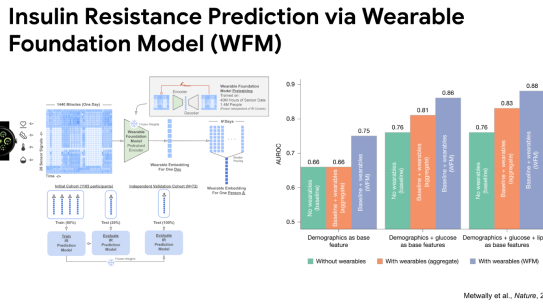
Graph 2: Performance of the IR classification on the independent validation cohort based on various experimental settings. The y-axis is AUROC from 0.5 to 0.9. Bar one is without wearables, bar two is with wearables (aggregate), and bar three is with wearables (WFM). Section one on the bar graph is demographics as base feature. Bar one is 0.66, bar two is at 0.66, and bar three is at 0.75. Section two is demographics plus glucose as base features. Bar one is at 0.76, bar two is at 0.81, and bar three is at 0.86. Section three is demographics plus glucose plus lipids as base feature. Bar one is at 0.76, bar two is at 0.83, and bar three is at 0.88.