


Overview
NYU Tandon environmental scientists design sustainable solutions to preserve, protect, and restore complex natural and built ecosystems. In the M.S. in Environmental Science program, you will gain a strong foundation in environmental chemistry, microbiology, and hydrology alongside the regulatory and policy frameworks that govern human-environmental interactions. You’ll learn how to monitor ecological systems, evaluate pollutant fate and transport, and remediate contamination through hands-on laboratory investigation and applied data analytics. Whether your focus is climate resilience, urban water cycles, or ecological protection, you will develop the skills to translate scientific discovery into actionable environmental stewardship.
Prerequisites
Students must hold a Bachelor of science degree in a related science or engineering discipline from an accredited institution with a minimum undergraduate GPA of 3.0 on a 4.0 scale. Applicants should demonstrate technical background in the following areas:
- Two semesters of college chemistry (with laboratory)
- One semester of college calculus
- One semester of college statistics
- One semester of an additional science course
- One semester of water resources or hydrology
- One semester of environmental processes
- Proficiency in data analytics and computer-based problem solving
Note for applicants: International applicants must complete all prerequisite subjects prior to applying. Domestic applicants who lack water resources and environmental processes coursework may satisfy this requirement after enrollment by taking Fundamentals of Environmental Engineering (CE-UY 3223) during its first offering.
Application Requirements
- Online application
- Official transcripts
- Resume
- Statement of purpose
- 2 Letters of recommendation (optional)
- English Language Proficiency Testing (where applicable)
- $90 Application fee
Find out more about Admission Requirements.
Tuition varies based on your program, term admitted, and credit hours.
We are committed to keeping graduate studies affordable for all of our students. You'll have access to on-campus employment programs that include teaching and research assistantships, as well as financial aid, scholarships, grants, and loans.
Explore our Tuition, Financial Aid, and Scholarships page to learn more about these opportunities.
Prospective Students
For questions about the application process, application status or to talk to an admissions counselor:
Office of Graduate Enrollment and Admissions
NYU Tandon School of Engineering
engineering.gradinfo@nyu.edu
646-997-3812
Accepted and Enrolled Students
For questions about the curriculum, advisement, or courses:
Department of Civil, Urban, and Environmental Engineering
NYU Tandon School of Engineering
6 MetroTech Center, Jacobs Hall RH 400
Brooklyn, NY 11201
cuee@nyu.edu
646-997-3577
For advising questions:
Professor André J. Butler
Industry Professor & Academic Advisor
ajbutler@nyu.edu
646-997-3713
#20
Top Colleges for Engineering Salaries
(Wall Street Journal)
#42
Best Engineering Graduate Schools in the Nation
(U.S. News & World Report)
#20
Research Institution in North America
(Nature)
The NYC Advantage
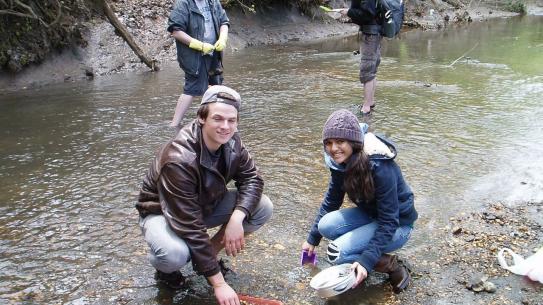
NYU Tandon Environmental Science Master’s students experience New York City as an active living laboratory for urban ecology and environmental resilience. Facing dense coastal geography, complex municipal water networks, and ambitious municipal climate adaptation mandates, NYC provides direct exposure to frontline environmental challenges. Studying in Brooklyn, you will have opportunities to collaborate with leading regional organizations, environmental consulting firms, and public agencies such as the NYC Department of Environmental Protection (DEP) and the New York State Department of Environmental Conservation (DEC), giving you a powerful urban platform to advance ecological protection.

Career Outcomes
The Master's in Environmental Science program prepares students for careers as an environmental scientist, climate scientist, water quality scientist, air quality scientist, environmental policy analyst, and more.
Specifically, students will be able to:
- Fundamentally understand the science and applied engineering of natural and manmade environmental systems;
- Evaluate the interactions between man and the environment and control adverse impacts of pollution on ecological systems;
- Understand the monitoring and laboratory analysis of environmental systems; and
- Participate actively in a multidisciplinary team of professionals to solve environmental problems.
Since the 1990s, NYU’s Wasserman Center for Career Development has conducted the Life Beyond the Square Survey to track NYU graduates’ career trajectories. Visit the Tandon Graduate Employment Dashboard and select “Masters” and “Tandon School of Engineering” for insights on recent alumni outcomes.
Curriculum
The Master's in Environmental Science is a 30-credit program. To graduate, students must complete all program requirements with a minimum GPA of 3.0 in both graduate coursework and guided studies (including readings, projects, theses, and dissertations). GPA averages for coursework and guided studies are computed separately, and transfer credits from other institutions are not included in these averages.
| Requirement Area | Credits |
|---|---|
| Core Courses | 9 |
| Approved Courses | 12 |
| Electives | 9 |
| Total Credits | 30 |
Meet Our Faculty








Civil Engineering, M.S.

Environmental Engineering, M.S.

Transportation Systems, M.S.
To earn a Master of Science in Environmental Science, students must complete 30 credits (consisting of 9 credits of core coursework, 12 credits of approved departmental electives, and 9 credits of general electives) while maintaining a minimum cumulative GPA of 3.0.
The M.S. in Environmental Science is an on-campus degree with flexible study options for full-time or part-time enrollment. Full-time students typically complete their 30 credits in 3 to 4 semesters.
-
Fall Semester: December 1 (Priority Consideration)
February 15 (General Consideration)
- Spring Semester: November 1
- Online application
- Official transcripts
- Resume
- Statement of purpose
- 2 Letters of recommendation (optional)
- English Language Proficiency Testing (where applicable)
- $90 Application fee
Students have access to dedicated wet chemistry, microbiology, and environmental testing laboratories in the Department of Civil, Urban, and Environmental Engineering. These facilities support testing in water and wastewater quality, soil mechanics, GIS and geomatics, alongside university-wide research resources at the NYU Center for Urban Science and Progress (CUSP) and the NYU MakerSpace.
Applicants holding a Bachelor's degree in other science fields or non-environmental engineering disciplines are encouraged to apply, provided they meet foundational coursework prerequisites in chemistry, calculus, and statistics. If you are transitioning from a non-STEM field or need to build quantitative and computing skills, the NYU Tandon Bridge program provides a structured online pathway to prepare you for graduate-level study at NYU Tandon.
Working alongside our leading New York City-based faculty, you will engage in high-impact research, scholarly initiatives, and funded projects across vital urban and environmental engineering domains, including:
- Natural and Urban Environmental Systems Management: Developing ecological frameworks, monitoring protocols, and adaptive management strategies for complex urban biomes and green infrastructure.
- Food-Resilient Cities and Vulnerability Mapping: Utilizing spatial data analytics and socio-economic modeling to identify supply chain vulnerabilities, mitigate food deserts, and build regional food security.
- Urban Water Cycle and Watershed Studies: Analyzing urban hydrological dynamics, stormwater runoff modeling, combined sewer overflow (CSO) management, and regional watershed protection.
- Contamination Remediation: Designing biochemical, physical, and engineered remediation techniques to decontaminate brownfields, municipal soils, and urban groundwater systems.
- Climate Change Impacts and Anthropogenic Interactions: Modeling sea-level rise, coastal flooding vulnerabilities, extreme heat stress, and the systemic feedback loops between human development and regional ecosystems.
- Water and Energy Supply-Demand Chains: Optimizing interdependent municipal utility networks, advancing water-energy nexus modeling, and strengthening the resilience of critical urban resource distribution systems.
Successful applicants holding a Bachelor's degree typically have completed foundational preparation across science, mathematics, and environmental systems:
- Chemistry: Two semesters of college chemistry with laboratory sessions.
- Mathematics and Analytics: One semester of college calculus, one semester of college statistics, and training in data analytics and computer-based problem-solving.
- General Science: At least one semester of an additional science course.
- Disciplinary Prerequisites: One semester of water resources or hydrology, and one semester of environmental processes.
Applicant Policies
- International Applicants: You must have all of these prerequisite coursework requirements fully completed prior to submitting your application.
- Domestic Applicants: If you have not completed prior coursework in water resources and environmental processes, you may still be considered for admission. You can satisfy these two requirements by enrolling in Environmental Engineering (CE-UY 3223) during its very first course offering following your matriculation in the M.S. program.