


Overview
At the NYU Tandon School of Engineering, our M.S. in Environmental Engineering program empowers you to design sustainable engineering solutions that preserve our vital natural resources in an era of rapid urbanization and climate impact. Rooted in the dynamic urban ecosystem of New York City, our curriculum immerses you in the critical challenges shaping modern infrastructure and public health. As a student in the program, you will master the principles of environmental systems modeling, water security and flood mitigation, air quality monitoring, and contaminated site remediation. Working alongside world-class faculty in state-of-the-art facilities, you will gain the technical expertise, data analytics acumen, and systems-thinking required to lead transformative environmental initiatives across public, private, and research sectors.
A Bachelor of Science degree in an engineering discipline (such as environmental, civil, chemical, or mechanical engineering) or in the physical, chemical, or biological sciences from an accredited U.S. institution or a recognized international university, with a minimum undergraduate GPA of 3.0 on a 4.0 scale.
Application Materials:
- Online application
- Official transcripts
- Resume
- Statement of purpose
- 2 Letters of recommendation (optional for M.S. applicants)
- English Language Proficiency Testing (where applicable)
- $90 Application fee
Find out more about Admission Requirements.
Tuition varies based on your program, term admitted, and credit hours.
We are committed to keeping graduate studies affordable for all of our students. You'll have access to on-campus employment programs that include teaching and research assistantships, as well as financial aid, scholarships, grants, and loans.
Explore our Tuition, Financial Aid, and Scholarships page to learn more about these opportunities.
Prospective Students
For questions about the application process, application status or to talk to an admissions counselor:
Office of Graduate Enrollment and Admissions
NYU Tandon School of Engineering
engineering.gradinfo@nyu.edu
Phone: 646-997-3812
Accepted and Enrolled Students
For academic questions, curriculum advisement, and graduate registration:
Department of Civil, Urban, and Environmental Engineering
NYU Tandon School of Engineering
Jacobs Hall, RH 400, 6 MetroTech Center
Brooklyn, NY 11201
646-997-3633
Department Academic Advisor:
Professor André J. Butler
abutler@nyu.edu
646-997-3600
At a Glance
#20
Research Institution in North America
(Nature)
#54
Best Environmental Engineering Programs
(U.S. News & World Report)
$107,110
Median annual wage for environmental engineers
(U.S. Bureau of Labor Statistics)
Market Outlook
Career Outcomes
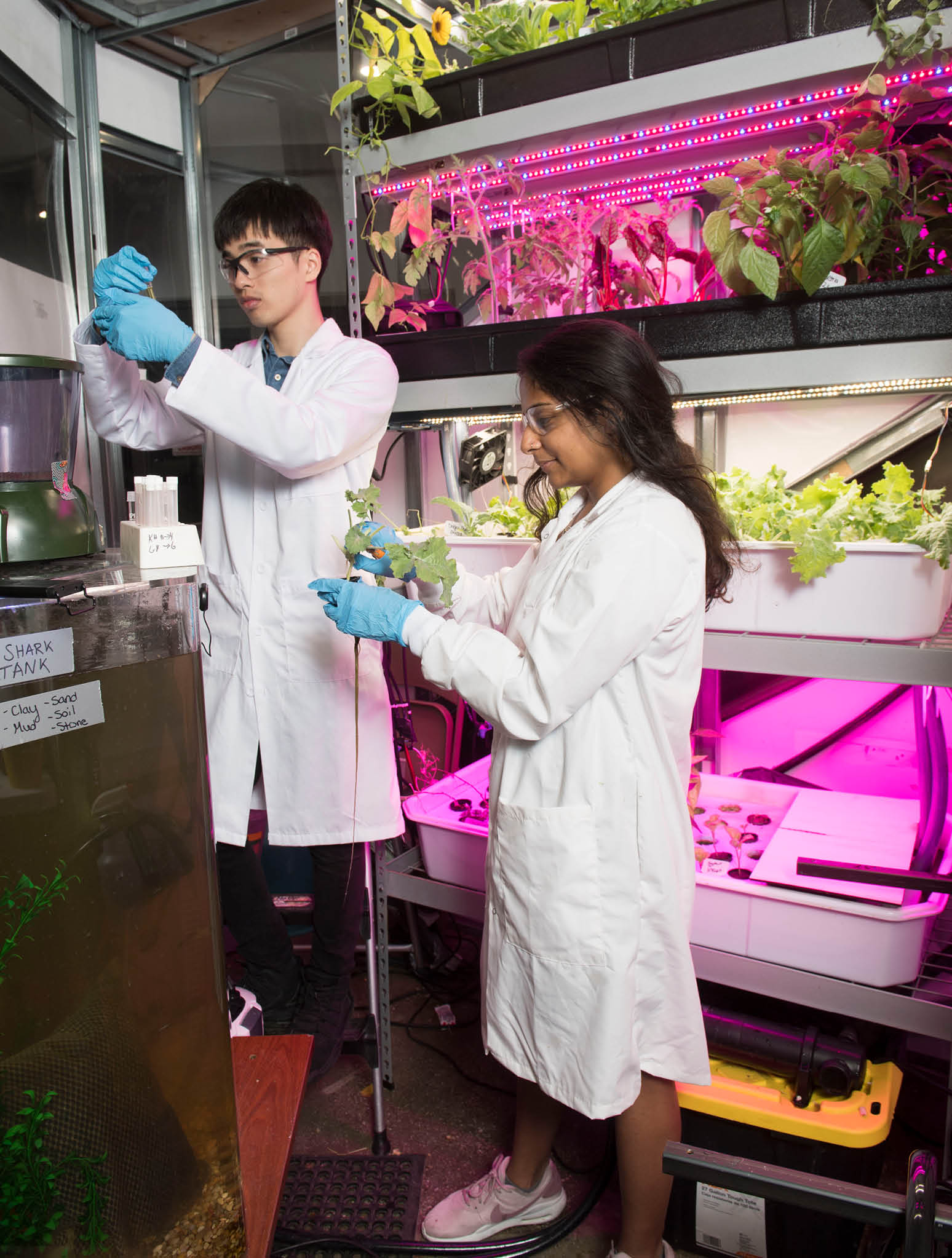
The Master's in Environmental Engineering program prepares students for successful careers in a wide variety of job sectors, including industry, consulting firms, and municipal, state, and federal government agencies. Students develop skills to become environmental engineers, environmental remediation engineers, water resources or water treatment engineers, air quality engineers, environmental planners, sustainability consultants, and more.
Specifically, graduates will be able to:
- Fundamentally understand the science and engineering of natural and man-made environmental systems
- Functionally design air, water, and waste treatment systems and components
- Control and operate environmental facilities
- Understand the modeling and simulation of environmental systems
- Participate actively in multidisciplinary teams to solve environmental problems
NYC Advantage
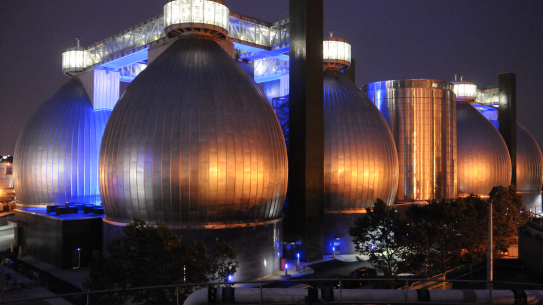
Studying environmental engineering at NYU Tandon places you at the center of one of the world's most complex, dense urban environments—turning New York City into your living laboratory. From the protection of the historic New York City drinking water supply and watershed system to managing local coastal flood risks and brownfield remediation, you will directly investigate the environmental challenges that global megacities face today. Our Brooklyn campus positions you steps away from regional municipal agencies, including the NYC Department of Environmental Protection (DEP), the Port Authority of New York and New Jersey, and leading civil and environmental engineering consultancies, giving you unmatched access to field site inspections, high-impact internships, and influential professional networks.
Curriculum
The Master's in Environmental Engineering is a 30-credit program. To graduate, students must complete all program requirements with a minimum GPA of 3.0 in both graduate coursework and guided studies (including readings, projects, theses, and dissertations). GPA averages for coursework and guided studies are computed separately, and transfer credits from other institutions are not included in these averages.
| Requirement Area | Credits |
|---|---|
| Core Courses | 12 |
| Major Courses | 9 |
| Electives | 9 |
| Total Credits | 30 |
Meet Our Faculty and Alumni


Meet Alma Rocha
Honored with an American Association of University Women (AAUW) Doctoral Fellowship






Civil Engineering, M.S.
Environmental Science, M.S.

Transportation Systems, M.S.
To earn the Master of Science in Environmental Engineering, you must complete 30 graduate credits with a minimum overall GPA of 3.0 across both formal coursework and guided studies.
The M.S. in Environmental Engineering is offered on-campus at NYU Tandon's Brooklyn location, with options for both full-time and part-time study schedules to accommodate your professional needs.
The program admits students for both the Fall and Spring terms:
Fall Semester:
- December 1: M.S. priority consideration
- February 15: M.S. general consideration
Spring Semester:
- November 1: Final application deadline for all M.S. applicants
Applicants must submit:
- Online application
- Official transcripts
- Resume
- Statement of purpose
- 2 Letters of recommendation (optional for M.S. applicants)
- English Language Proficiency Testing (where applicable)
- $90 Application fee
Successful applicants typically demonstrate a strong quantitative and scientific foundation through prior undergraduate coursework, including:
- Mathematics: Three semesters of calculus, including ordinary differential equations
- Statistics: One semester of college-level statistics
- Physics & Chemistry: One semester of calculus-based physics and one semester of college-level chemistry
- Engineering & Environmental Fundamentals:
- One semester of fluid mechanics
- One semester of water resources engineering or hydrology
- One semester of environmental process engineering
- Computing: Training in computer-based problem-solving
Note: You must earn a minimum grade of B in each preparatory course. These undergraduate foundational courses serve to satisfy prerequisites and do not count toward the 30 graduate credits required for the master's degree.
If you are coming from a non-technical background, the NYU Tandon Bridge program provides an official pathway to build your foundational engineering and quantitative competencies.
Delivered entirely online with flexible, self-paced learning options, this preparatory program is specifically designed to equip students without prior STEM degrees or formal coursework with the prerequisite skills, computational principles, and technical rigor needed to qualify for and succeed in graduate Master's degree programs across NYU Tandon.
You will collaborate alongside faculty on high-impact research across six key environmental and water resource areas:
- Environmental Systems: Real-time monitoring, sensor deployment, and environmental data visualization.
- Water Security & Flood Risk: Hydrodynamic flood modeling, watershed protection, and transboundary water conflict resolution.
- Water Quality & Groundwater Modeling: Contaminant transport simulations and groundwater protection.
- Waste Management & Remediation: Hazardous waste mitigation, soil and brownfield decontamination, and solid waste systems.
- Climate Change Studies: Regional climate impacts, sea-level rise modeling, and urban infrastructure adaptation.
- Decision Support Systems & GIS: Spatial data analytics and multicriteria decision-making for sustainable resource planning.
Our M.S. in Environmental Engineering program equips you for leadership and technical careers across diverse job sectors, including industry, specialized environmental consulting firms, and municipal, state, and federal government agencies. The curriculum develops the rigorous skills required to step into roles such as environmental engineers, environmental remediation engineers, water resources or water treatment engineers, air quality engineers, environmental planners, and sustainability consultants.
Graduates of the program develop the expertise to:
- Fundamentally understand the science and engineering governing both natural and man-made environmental systems
- Functionally design air, water, and waste treatment systems and components
- Control and operate complex environmental facilities
- Apply advanced modeling and simulation techniques to analyze environmental systems
- Participate actively and effectively in multidisciplinary teams to solve pressing environmental challenges
The NYU Wasserman Center for Career Development has conducted the Life Beyond the Square survey to monitor the employment data and career trajectories of our graduates. To explore recent employment rates, top hiring organizations, and career destinations for our alumni, visit the Tandon Graduate Employment Dashboard and filter by "Masters" and "Tandon School of Engineering."
Students have access to departmental experimental and computing facilities, including specialized water quality, hydraulics, and environmental remediation research spaces within the Department of Civil, Urban, and Environmental Engineering. Students can also leverage cross-disciplinary hubs such as the CUSP (Center for Urban Science + Progress) and the 10,000-square-foot NYU Tandon MakerSpace for rapid prototyping, sensor fabrication, and data visualization.