
A Software Engineer Finds a New Mission
Alum Regvina Oliveira’s world encompasses both the high tech and the artisan made

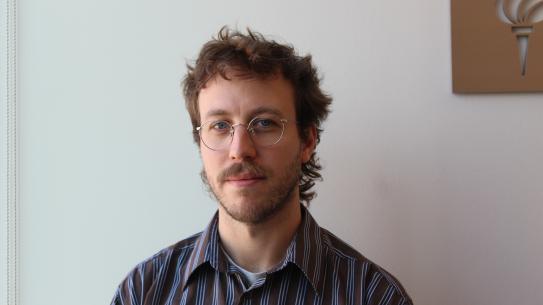
Daniel Schwartz and alumna Regvina Oliveira (‘15)
When Tandon alumna Regvina Oliveira (‘15) and her now-husband traveled to India in 2022 before getting engaged, they left with unique gifts for those back home and the idea for an enterprise to give Kashmiri artisans the credit and income they deserve.
The trip was supposed to be about family. Regvina was bringing her partner — Daniel Schwartz, a New York-based anesthesiologist and critical-care physician — to India to meet her relatives. What neither of them expected was that the visit would also introduce them to people who would, a few years later, partner with them from halfway around the world.
Between family dinners and the rituals of a serious first meeting, the couple found themselves drawn into the workshops of Kashmiri artisans — the spinners, weavers, and embroiderers whose hands produce some of the most coveted textiles in the world. They watched a grandmother smooth a single thread of pashmina across a small wooden frame. They sat at the foot of a handloom that had been worked by the same family for generations. They learned, slowly, how a finished shawl is the sum of months of patient, almost invisible labor. And they noticed something else: when those shawls eventually surfaced in luxury boutiques in Paris, Milan, or New York City, the people who had actually made them were seemingly invisible.
Once the couple flew home, the idea for the House of Artiglo took shape. Today, the company — founded by Regvina and Daniel, with Oliveira's sister, Limisha (a web designer and digital strategist), also closely involved — exports handmade Kashmiri shawls, wraps, and accessories to customers in the United States, while putting the artisans' names, faces, and stories at the center of the brand.
The GOAT
To understand why a House of Artiglo shawl can take months to make, you have to begin not in a workshop but on a high Himalayan plateau, in the company of an unusually hardy goat.
The Changthangi, a rare breed native to the Changthang region of Ladakh and Tibet, lives at altitudes where winter temperatures plunge far below freezing. To survive, each goat grows a soft, downy undercoat (a fiber called pashm) beneath its outer coat. In early spring, as the animals begin to molt naturally, herders gently comb the loosened down out by hand. The goats are not sheared. Each animal yields only a small amount of usable pashm a year, which is part of why true pashmina has been treasured for centuries, and part of why mass-market imitations bear so little resemblance to the real thing. From the plateau, the raw fiber travels to the Kashmir Valley, where it enters a chain of households that have been refining it for generations.
The Artisans
Among the artisans whose work House of Artiglo carries are a weaver named Ahmad and his mother, Rukhsana Bano. They work, as their family has worked for generations, around a wooden handloom that sits at the center of their home. Rukhsana prepares the warp by hand. Using a small wooden frame, she winds and stretches each skein of pashmina, hand-spinning the threads, smoothing and strengthening every strand before it is ever set on the loom. It is the kind of step that customers never see and that machines have never managed to replicate at the same level of fineness. Ahmad then weaves — slowly, in even rhythm, the cloth growing by fractions of an inch at a time.
A single fine pashmina shawl can take weeks of combined work between spinner, weaver, and, if the design calls for it, an embroiderer trained in sozni — the fine needlework, often passed from one generation to the next, that turns a length of woven pashmina into something closer to a painting.
Regvina explains that the decision to put the artisans front and center was a direct reaction to what they observed in the wider luxury market. A scarf made by Ahmad and his mother might be sold, eventually, under a designer label thousands of miles away — with the maker's name absent from the tag, the website, and the price.
House of Artiglo's site, by contrast, reads almost as much like an oral history as a catalog. Each collection is paired with photographs and short profiles of the people who produced it. The company has also committed to directing a portion of its proceeds to education initiatives in India, with a particular focus on schooling for girls from underprivileged families.
Kashmir First, Then the World
Kashmir is where the company began, but the founders see it as a starting point rather than a final destination. The plan, eventually, is to apply the same model to artisan traditions in other parts of the world — leather goods from Italian workshops, for instance, where the disconnect between maker and label can be just as pronounced as it is in the cashmere trade. Wherever they expand, the rule will be the same: credit the people, tell their stories, share the proceeds, and trust that customers want to know.
An Engineer and an Anesthesiologist Walk into a Loom Workshop
It is, on paper, an unlikely founding team. Regvina graduated from NYU Tandon in 2015 with a degree in computer science and has spent her career as a software engineer at such companies as Spotify, American Express, and Squarespace — building the kind of high-traffic digital products in which scale, automation, and speed are practically the point. Daniel, for his part, spends his working hours in healthcare settings, where the relevant tools are pharmacology and physiology rather than warp threads and sozni needles.
Neither came to the House of Artiglo with a background in textiles, in fashion, or in export. What Regvina did bring was an engineer's instinct for systems — for how a supply chain ought to work if you are designing it from scratch with transparency as a requirement rather than an afterthought — and the discipline of someone used to building things that have to keep functioning when nobody is watching. The crafts the company sells could hardly be further from the products she has shipped in her day jobs, but the underlying question is recognizable from either world. Who built this thing, and are they being treated fairly for the work?
On the answer to that question, a family of STEM-focused professionals in New York City and a family of weavers in Kashmir have managed to agree.