
Invisible Infrastructure, Visible Ethics: Tandon Senior Wins Regional ASCE Mead Prize
Matteo Przyszczykowski's essay explores the hidden costs of America's data center boom

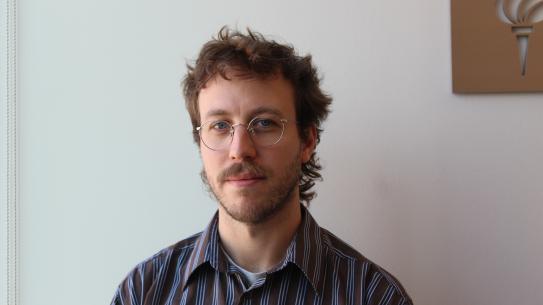
Senior Matteo Przyszczykowski
Civil Engineering seniors at NYU Tandon are all required to take CE-UY 4092 Leadership, Business Principles, Policy, and Ethics. One of their class assignments is to prepare an essay on an ethics-related topic that is the basis for the annual ASCE Daniel W. Mead Prize for Students. The student who submits the best paper in Professor Larry Chiarelli’s class presents it at the regional ASCE Metropolitan Student Symposium. This year’s honor went to Matteo Przyszczykowski, who will be heading off to London Business School in September to earn a Master of Management degree. Matteo’s paper and compelling presentation – "Invisible Structures, Visible Consequences: Ethics and Data Centers in Civil Engineering" – placed first and will be the region’s nominee for the national prize.
Established in 1939 by ASCE past president Daniel W. Mead, the prize draws one submission from each ASCE regional student conference. This year's prompt asked entrants to wrestle with a deceptively simple question: how should civil engineers honor the historical, cultural, and social needs of the communities they build for?
Przyszczykowski’s answer to this year’s question pulls back the curtain on something many of us interact with regularly yet rarely think: data centers. There are now 4,174 of them spread across all 50 states, humming quietly behind every text, transaction, and TikTok. By 2030, the International Energy Agency projects that U.S. data centers will consume more electricity than all the country's energy-intensive manufacturing combined, including aluminum, steel, cement, and chemicals. These facilities, Przyszczykowski argues, are infrastructure hiding in plain sight: dependent on roads, power grids, water systems, and land — all the unglamorous things civil engineers actually build.
So who pays for the convenience? In his essay, Matteo lays out the receipts. Electricity bills near major data center clusters have climbed dramatically. A proposed AI-focused campus in Tucson — sited on ancestral Indigenous homelands in a desert already short on water — could draw up to five million gallons a day. The Navajo Nation has pushed back against transmission projects routed through its lands to serve distant tech giants.
The paper proposes a sensible roadmap based on successes already in place. He points to Facebook's Prineville, Oregon, facility, where genuine community engagement turned a controversial project into 200 construction jobs, 35 full-time positions, and over a million dollars in city fees for a town of 10,000. He also highlights a data center in Odense, Denmark, that captures its own waste heat to warm nearly 11,000 homes and businesses every year, turning a byproduct into a public good. And he makes the case for community benefit agreements, sustainability certifications like LEED and Envision, and a philosophy he sums up neatly: engineering with communities, not for them.
"In the 21st century," he writes, "'public welfare' encompasses not only physical safety but also digital fairness, energy equity, and sustainable progress." It's a sharp argument from a soon-to-be graduate who clearly intends to do more than build to spec.
Congratulations to Matteo and to NYU Tandon's ASCE Student Chapter — advised by Industry Professor Jose M. Ulerio — for shepherding the submission to the national stage.