
Maurizio Porfiri
-
Civil, Urban, and Environmental Engineering Department Interim Chair
-
Institute Professor
-
Director of Center for Urban Science + Progress (CUSP)
-
Director of the Urban Institute

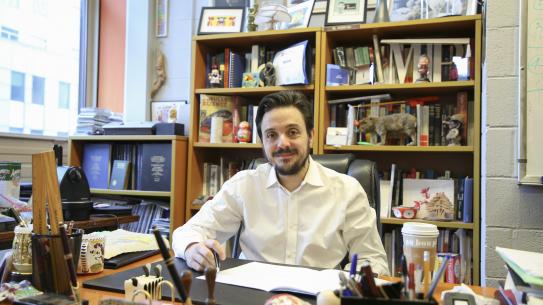
Dr. Maurizio Porfiri is an Institute Professor at New York University Tandon School of Engineering, with tenured appointments at the Departments of Mechanical and Aerospace Engineering and Biomedical Engineering. He is also the Director of the Center for Urban Science + Progress and Interim Chair of the Civil, Urban, and Environmental Engineering Department at NYU Tandon, as well as the inaugural Director of the Urban Institute. He also also an Associated position in the Department of Technology Management and Innovation. He received M.Sc. and Ph.D. degrees in Engineering Mechanics from Virginia Tech, in 2000 and 2006; a “Laurea” in Electrical Engineering (with honors) and a Ph.D. in Theoretical and Applied Mechanics from Sapienza University of Rome and the University of Toulon (dual degree program), in 2001 and 2005, respectively. He has been on the faculty of the Mechanical and Aerospace Engineering Department since 2006, when he founded the Dynamical Systems Laboratory.
Dr. Porfiri is a Fellow of the American Society of Mechanical Engineers (ASME) and the Institute of Electrical and Electronic Engineers (IEEE). He has served in the Editorial Board of ASME Journal of Dynamics systems, Measurements and Control, ASME Journal of Vibrations and Acoustics, Flow: Applications of Fluid Mechanics, IEEE Control Systems Letters, IEEE Transactions on Circuits and Systems I, IEEE Transactions on Network Science and Engineering, Mathematics in Engineering, and Mechatronics. Dr. Porfiri is engaged in conducting and supervising research on complex systems, with applications from mechanics to behavior, public health, and robotics.
He is the author of approximately 450 journal publications, including papers in Nature, Nature Cities, Nature Communications, Nature Human Behaviour, Physical Review Letters, and Proceedings of the National Academy of Sciences. He was included in the “Brilliant 10” list of Popular Science in 2010 and his research featured in major media outlets, such as CNN, NPR, Scientific American, and Discovery Channel. Other significant recognitions include National Science Foundation CAREER award; invitations to the Frontiers of Engineering Symposium and the Japan-America Frontiers of Engineering Symposium organized by National Academy of Engineering; invitations to the third and fourth World Laureate Forums; the Outstanding Young Alumnus award by the college of Engineering of Virginia Tech; the ASME Gary Anderson Early Achievement Award; the ASME DSCD Young Investigator Award; the ASME C.D. Mote, Jr. Early Career Award; the Research Excellence Award from New York University Tandon School of Engineering; the Aspen Italia Award for Scientific Research and Cooperation; and a Microsoft Research Fellowship.
Education
Sapienza University of Rome, 2001
Laurea (B.Sc./M.Sc.), Electrical Engineering
Sapienza University of Rome, 2005
Doctor of Philosophy, Theoretical and Applied Mechanics
Virginia Polytechnic Institute & State University, 2000
Master of Science, Engineering Mechanics
University of Toulon, 2005
Doctor of Philosophy, Theoretical and Applied Mechanics
Virginia Polytechnic Institute & State University, 2006
Doctor of Philosophy, Engineering Mechanics
Experience
NYU Tandon School of Engineering
CUE Interim Chair
From: October 2025 to present
NYU
Urban Institute Director
From: October 2022 to present
NYU Tandon School of Engineering
CUSP Director
From: September 2022 to present
NYU Tandon School of Engineering
Institute Professor
From: January 2020 to present
NYU Tandon School of Engineering
Professor
From: September 2014 to present
NYU Tandon School of Engineering
Associate Professor
From: September 2011 to August 2014
NYU Tandon School of Engineering
Assistant Professor
From: July 2006 to September 2011
Virginia Polytechnic Institute and State University
Post-Doctoral Associate
From: July 2005 to June 2006
Publications
Journal Articles (recent selection)
- Ancona, C., Lauber, O., Rozhkov, A., Porfiri, M.: "Urban infrastructure and fossil-fuel industrial legacy drive U.S. data center siting", Nature Cities in press
- Xiedeng, D., Celli, P., Porfiri, M., 2026: "Dynamic stabilization of a mechanical oscillator in the absence of any stable feature", Nature Communications 17, 6024
- Succar, R., Porfiri, M., 2025: "Detecting directional coupling in network dynamical systems via Kalman’s observability", Physical Review Letters 134 (7), 077401
- Gan, T., Dighe, T., Porfiri, M., 2025: "Trade-off between diversity and provision of specialized healthcare in U.S. cities", Nature Cities 2, 980–989
- Succar, R., Porfiri, M., 2024: "Urban scaling of firearm violence, ownership, and accessibility in the United States", Nature Cities 1, 216–224
- Falcucci, G., Amati, A., Bella, G., Krastev, V. K., Polverino, G., Succi, S., Porfiri, M., 2024: "Adapting to the abyss: passive ventilation in the deep-sea glass sponge Euplectella aspergillum", Physical Review Letters 132, 208402
- Succar, R., Barak Ventura, R., Belykh, M., Wei, S., Porfiri, M., 2023: "Fame through surprise: How fame-seeking mass shooters diversify their attacks", Proceedings of the National Academy of Sciences of the United States of America 120(20), e2216972120
- Falcucci, G., Amati, G., Fanelli, P., Krastev, V. K., Polverino, G., Porfiri, M., Succi, S., 2021: "Extreme flow simulations reveal skeletal adaptations of deep-sea sponges", Nature 595, 537–541
- Porfiri, M., 2020: "Validity and limitations of the detection matrix to determine hidden units and network size from perceptible dynamics", Physical Review Letters 124(16), 168301
- Porfiri, M., Sattanapalle, R. R., Nakayama, S., Macinko, J., Sipahi, R., 2019: "Media coverage and firearm acquisition in the aftermath of a mass shooting", Nature Human Behaviour 3(9), 913-921
Awards
- European Academy of Sciences (EURASC) Fellow, 2026
- Microsoft Research Fellowship, 2026
- Aspen Institute Italia Award for Scientific Research and Cooperation, 2024
- Speaker for the Liviu Librescu Memorial Lecture, 2021
- Invitee to the 4th World Laureate Forum, 2021
- Invitee to the 3rd World Laureate Forum, 2020
- Institute Professor at NYU Tandon School of Engineering, 2020
- ASME Fellow, 2019
- IEEE Fellow, Control Systems Society, 2019 ("For contributions to networked control systems and biomimetic robotics")
- ASME C.D. Mote, Jr. Early Career Award, 2015
- Invitee of Japan-America Frontiers of Engineering Symposium, National Academy of Engineering, 2014
- Jacobs Excellence in Education Award, 2014
- ASME Dynamic Systems & Control Division Young Investigator Award, 2013
- ASME Gary Anderson Early Achievement Award, 2013
- Outstanding Young Alumnus, College of Engineering Virginia Polytechnic Institute and State University, 2012
- Invitee of Frontiers of Engineering Symposium, National Academy of Engineering, 2011
- Jacobs Excellence in Education Award, 2011
- Popular Science "Brilliant Ten", 2010
- NSF Career award (Dynamical systems), 2008
- H2CU medal, 2008
Research News

Ready, Set, March: Researchers Use Math to Explain Sudden Activity Bursts in Ants
Scientists have long known that ant colonies sometimes seem to move as one. A nest that appears quiet can suddenly erupt into activity, with workers throughout the colony springing into motion almost simultaneously before settling back into stillness.
These synchronized bursts, first documented more than three decades ago, have intrigued biologists because they resemble collective phenomena seen in systems as diverse as neurons, fireflies and even chemical reactions.
Now, new research from engineers and biologists at New York University and the New Jersey Institute of Technology offers a mathematical explanation for how these rhythmic waves of activity emerge.
The study, published in Physical Review X Life, suggests that synchronized bursts arise when a colony balances two competing forces: the ability of a single active ant to rapidly excite its nestmates and the colony’s capacity to fully return to rest before the next wave begins.
Using a computational model grounded in empirical observations of ant behavior, the researchers found that colonies undergo a kind of phase transition — a sudden shift from unsynchronized movement to coordinated collective activity.
“Activity bursts emerge as a balance between the responsiveness of the colony to the first ant that activates and the ability of the colony to completely deactivate before the onset of the next burst,” said lead author Michael Napoli, a doctoral researcher in the Department of Mechanical and Aerospace Engineering at NYU.
The team combined decades of observations of ant movement with established theories of social activation. In the model, ants can occupy one of three states: active, inactive or refractory — a temporary resting period during which they cannot immediately become active again. Active ants move through a virtual nest and interact with others, sometimes triggering them to become active as well.
What emerged from the simulations was a surprisingly powerful role for individual workers. Rather than requiring many ants to coordinate simultaneously, a single ant often acted as the spark that ignited a colony-wide cascade of activity.
The researchers call this worker the “first mover.” Once activated, that ant can stimulate others, which in turn activate additional nestmates, creating a rapid chain reaction that sweeps through the colony. The process resembles a line of falling dominoes or the spread of information through a social network.
“Our results indicate that activity bursts in ant colonies are the result of a first mover that excites the colony in a synchronized regime, thereby favoring the rapid communication of new behaviors throughout the group,” the authors write.
The study also revealed that speed matters. Ants appear to operate in what the researchers describe as a “high-speed interaction regime,” where information spreads through the nest far more quickly than the duration of an activity burst itself. Under these conditions, workers constantly form and break social connections as they move, allowing information to travel efficiently across the colony.
According to senior author Maurizio Porfiri, the findings suggest that synchronized behavior depends not simply on how many interactions occur, but on how rapidly information can propagate through the network of moving individuals.
“The timescale of the motion of individuals through the nest is faster than that of the burst, suggesting that ants operate in a high-speed interaction regime where new behaviors are near-instantaneously transferred through the nest,” Porfiri said.
Although the study focuses on ants, its implications extend beyond insect societies. Simon Garnier, Professor of Biological Sciences at NJIT and coauthor on the paper, suggests similar leader-driven cascades appear in many complex systems, from grazing sheep that suddenly cluster together to neurons firing in coordinated patterns. By identifying the conditions that promote synchronization, the researchers hope to uncover general principles that govern collective behavior across biology.
The work could even inspire new approaches to engineering. Swarms of robots, for example, often rely on local interactions rather than centralized control. Understanding how a single agent can trigger coordinated action across a large population could help designers create more efficient systems for tasks such as warehouse logistics, environmental monitoring or disaster response.
The authors caution that their model simplifies many aspects of real ant colonies, including differences among workers and the complex spatial organization of nests. Future experiments will test whether real colonies operate near the synchronization threshold predicted by the model and whether manipulating density or movement patterns can alter the emergence of activity bursts.
For now, the research offers a compelling explanation for one of social insects’ most mysterious behaviors. What appears to be a colony acting with a single mind may actually begin with one ant taking the first step — and thousands of others rapidly following its lead.
This research was supported by a grant from the National Science Foundation.
Napoli, M., Garnier, S., & Porfiri, M. (2026). Nest-Level Phase Transition Drives Synchronized Activity Bursts in Ant Colonies. PRX Life, 4, 033010. doi:10.1103/ghnl-p5c1
Inside the Urban Machine: Where America's Data Centers Actually Live
Updated August 3, 2026 to include Note on Methodology and Terminology.
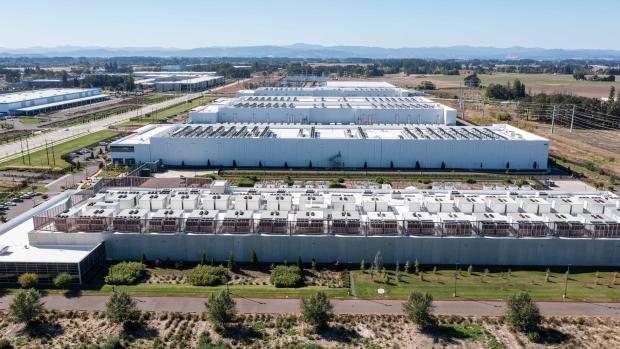
When people picture a data center, they often imagine something remote: a huge warehouse humming quietly far from the city. New research from NYU Tandon School of Engineering shows that assumption is largely wrong.
The study, published in Nature Cities, examined the locations of 4,283 data centers across the contiguous United States and found that 97.5% of them sit inside metropolitan or micropolitan statistical areas, meaning urban cores and their immediate surroundings.
The roughly 2.5% of facilities technically outside city limits are, on average, just 8.5 miles from the nearest urban edge. The cloud lives downtown.
"There is a prevailing narrative of these data centers being somewhere in the middle of nowhere, in rural areas, being a positive force for employment, and being the future of rural communities," said lead researcher, NYU Tandon Institute Professor Maurizio Porfiri, who is the Director of Tandon’s Center for Urban Science + Progress and of the NYU Urban Institute. "We dramatically challenged this view."
The concentration is striking even within the urban category. Five metro areas, Washington-Arlington-Alexandria, Chicago, Dallas-Fort Worth, New York-Newark-Jersey City, and Phoenix, account for nearly a third of all U.S. facilities. The Washington region alone hosts 610 data centers, reflecting Northern Virginia's status as the global capital of data infrastructure (see appendix).
So why cities?
The answer, the researchers found, suggests that a lot has to do with what’s already there and what used to be there.
The single strongest predictor is electricity capacity, meaning how much power local generators can produce. Data centers are power-hungry, running thousands of servers around the clock and drawing enormous, steady loads from the grid.
But a notable finding goes beyond electricity supply. Closed coal plants near cities are becoming magnets for new data center builds. When a plant shuts down, the power lines and grid connections built to carry electricity continuously do not disappear. Data center developers can tap directly into that infrastructure, or, in some cases, redevelop the sites themselves.
The numbers bear this out. Among cities that overlap with areas designated as Energy Communities under a 2022 federal policy, data centers under development are twice as likely to be found there than in cities without that designation (see appendix).
The policy was designed to direct clean-energy investment toward regions hurt by coal plant closures. The research suggests the digital economy may be taking root in many of the same places as the fossil fuel economy it is meant to succeed.
Because data centers draw from their local grid, their carbon footprint depends heavily on how that grid generates power. A typical data center in Montana or North Dakota produces more than 350,000 tons of CO2 emissions annually, while the average facility in Vermont, New Hampshire, or Arkansas produces less than 3,000 tons.
Beyond electricity supply, data centers also cluster where IT workers and high-speed internet are concentrated. Local water shortages seem to have less of an impact on data center placement, despite the facilities consuming enormous amounts of water for cooling.
The opacity of the industry compounds all of these problems.
“As this industry rapidly grows, the limited publicly available data on its footprint creates a real challenge,' said Ofek Lauber Bonomo, a postdoctoral researcher in Porfiri’s Dynamical Systems lab and a paper co-author. “That makes it more difficult for planners, for local residents, and for anyone trying to make informed decisions about their community's future."
"The patterns we found were consistent and clear,” added Anton Rozhkov, a CUSP Industry Assistant Professor and paper co-author. “Where the infrastructure already exists, the data centers follow. The question now is whether that is the future we want to build.”
The Nature Cities paper follows the recent announcement that Porfiri and Camilla Ancona – a paper co-author and postdoctoral researcher in Porfiri’s Dynamical Systems Lab – were named among the 2026 cohort of Microsoft Research Fellows, to advance their work using AI-driven simulations to help utilities and regulators decide where to site data centers before breaking ground.
The research in the Nature Cities paper was supported by the NYU Abu Dhabi (NYUAD) Center for Interacting Urban Networks, funded by the Abu Dhabi government through the NYUAD Research Institute.
Ancona, C., Lauber Bonomo, O., Rozhkov, A. et al. Urban infrastructure and fossil fuel industrial legacy drive US data center siting. Nat Cities (2026). https://doi.org/10.1038/s44284-026-00487-z
Note on Methodology and Terminology:
This study analyzed a 2025 dataset of 4,283 commercial data centers in the contiguous United States from the commercial Data Center Map database. The dataset includes operational facilities as well as projects that were planned, under construction, or land-banked at the time of analysis. Throughout this article, "city" refers to metropolitan and micropolitan statistical areas (MSAs and MicroSAs), as defined by the U.S. Office of Management and Budget, which classify counties based on economic integration with an urban core rather than population density or land use. As a result, some counties classified as part of metropolitan or micropolitan areas may have low population density or predominantly rural land use. The study characterizes the overall geographic distribution of U.S. data centers by facility count during the study period.
Appendix
Data centers in each metro area - top 10
|
# |
Metro area |
Facilities |
Share of U.S. total |
|---|---|---|---|
|
1 |
Washington–Arlington–Alexandria |
610 |
14.2% |
|
2 |
Chicago–Naperville–Elgin |
241 |
5.6% |
|
3 |
Dallas–Fort Worth–Arlington |
192 |
4.5% |
|
4 |
New York–Newark–Jersey City |
163 |
3.8% |
|
5 |
Phoenix–Mesa–Chandler |
154 |
3.6% |
|
6 |
Atlanta–Sandy Springs–Roswell |
136 |
3.2% |
|
7 |
Columbus |
133 |
3.1% |
|
8 |
San Jose–Sunnyvale–Santa Clara |
130 |
3.0% |
|
9 |
Los Angeles–Long Beach–Anaheim |
90 |
2.1% |
|
10 |
Des Moines-West Des Moines |
76 |
1.8% |
Data centers in Energy Community (EC) designated areas - top 8
|
# |
Metro area |
Under-development data centers |
|---|---|---|
|
1 |
Chicago–Naperville–Elgin, IL–IN |
108 |
|
2 |
Dallas–Fort Worth–Arlington, TX |
58 |
|
3 |
Washington–Arlington–Alexandria, DC–VA–MD–WV |
26 |
|
4 |
San Antonio–New Braunfels, TX |
24 |
|
5 |
Reno, NV |
18 |
|
6 |
New Haven, CT |
12 |
|
7 |
Scranton–Wilkes-Barre, PA |
11 |
|
8 |
Monroe, LA |
10 |
Could Physics Replace the Computer Keeping Your Robot Upright?
A new discovery in physics could help engineers stabilize robots and structures without relying on complex sensors and control systems, and design metamaterials and network systems that are presently beyond reach.
The finding, published in Nature Communications by researchers at NYU Tandon School of Engineering and Stony Brook University, shows that a mechanical system can be kept stable simply by switching between two behaviors at the right rhythm, even when neither behavior is stable on its own. No sensors watching the motion. No software constantly correcting it.
Once the timing is set, the physics does the rest.
Many machines must constantly stabilize their motion — keeping a walking robot from tipping over or preventing an aircraft wing from vibrating uncontrollably. Robots and other actively controlled systems typically do this by monitoring their environment and correcting their motion in real time, which requires sensors, processing power and software.
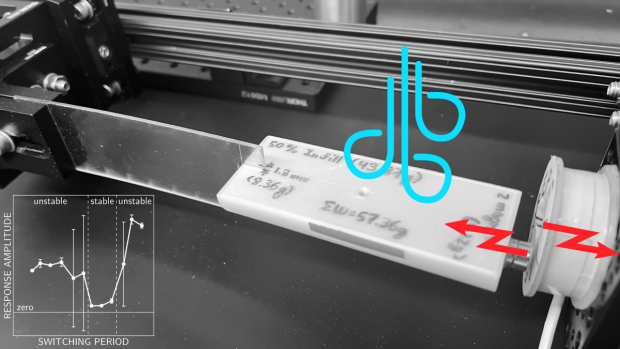
To test an alternative, the researchers built what they informally call the Frankenstein oscillator: a thin plastic strip fixed at one end with a small weight at the tip, subject to multiple loading conditions.
They then created two different kinds of instability. A magnetic coil pushed the beam away from its resting position in a way similar to a ball balanced on a horse’s saddle: if it moves slightly off center, it slides away in certain directions. A small fan blew air across the strip, feeding energy into the motion so that its swings grew larger rather than fading away, similar to how a playground swing rises higher when someone pushes at the right moment.
Both forces were switched on and off in carefully timed pulses.
The result was striking. Stability appeared only within a narrow band of switching speeds, with periods between roughly 218 and 238 milliseconds. Inside that window the beam stayed nearly still. Outside it, the motion quickly grew and the beam swung away.
Why should switching between two unstable behaviors make anything stable?
The idea builds on Kapitza's pendulum, named after Russian Nobel laureate Pyotr Kapitza. Vibrate the base of an inverted pendulum at exactly the right frequency and it stays upright, with no one watching or adjusting. Unlike a person balancing a stick on one hand, constantly shifting to stop it from falling, Kapitza's pendulum requires no such attention. Physics takes over.
In the classic case, the vibration provides a stabilizing effect, making the system virtually alternate between one stable and one unstable state. The new research asked a different question: what would happen if there were no stable states at all, if the physics were always pushing the system away from its resting position?
The answer depends on the type of instability involved. The “sliding” type — like the ball on the saddle — has one special direction in which motion actually shrinks instead of growing. The “swinging” type continually rotates the motion through different directions.
If the switching is timed correctly, that rotation can steer the motion into the shrinking direction before it has time to run away. The two instabilities, surprisingly, end up stabilizing each other.
“I have been thinking about the problem of stabilization of unstable systems through switching for over two decades,” said the paper’s senior author Maurizio Porfiri, an NYU Tandon Institute Professor and Director of both the NYU Urban Institute and the Center for Urban Science + Progress (CUSP). “In between ups and downs on the research, I was almost convinced that stabilization of two unstable systems would require some form of nonlinearity or even chaotic dynamics, but that is not the case: a simple, linear mechanical system can do the trick. The solution was in front of me for years, an extension of the marvelous ideas presented by Landau and Lifshitz in their Mechanics textbook that my uncle gave to me as a gift when I took my undergraduate dynamics class."
The researchers developed the theory first and then confirmed it experimentally with the beam. The narrow stability window they observed in the lab closely matched what the mathematical model predicted.
"Honestly, I had no belief that we would be able to demonstrate this phenomenon experimentally, as this involved working with a system that not only is unstable, but also features multiple sources of instability,” said Paolo Celli, Assistant Professor in Civil Engineering at Stony Brook University and co-corresponding author of the study. “The joy we felt when our carefully-designed experiment showed that narrow stability window is hard to explain. I am now super excited to see how this dynamic stabilization idea can be applied to other structural and robotic systems on the verge of instability"
The broader implication is a new design philosophy. Instead of always trying to eliminate instability, engineers may sometimes be able to build stable systems out of unstable pieces, harnessing the laws of physics rather than fighting them
The research was supported by the National Science Foundation through grants to both institutions. Along with Porfiri — who wrote about this research in a Behind the Paper post — and Celli, David Xiedeng — a Ph.D. student in Celli’s lab — is a co-author on the paper.

New Mathematical Model Shows How Economic Inequalities Affect Migration Patterns
For as long as there have been humans, there have been migrations — some driven by the promise of a better life, others by the desperate need to survive. But while the world has changed dramatically, the mathematical models used to explain how people move have often lagged behind reality. A new study in PNAS Nexus from a team led by Institute Professor Maurizio Porfiri argues that the patterns of human movement can’t be fully understood without reckoning with inequality.
For decades, researchers have relied on models that treat all cities and regions as if they were equal. The “radiation” and “gravity” models, the workhorses of mobility science, describe migration as a function of population size and distance: how many people live in one place, and how far they have to go to reach another. These equations have been useful for predicting broad commuting and migration trends, but they share a blind spot: they assume that opportunities and living conditions are evenly distributed. In a world where climate change, war, and widening economic divides are shaping the way people move, that assumption no longer makes sense.
Porfiri and his colleagues built a new model that explicitly incorporates inequality. It assigns each location a different “opportunity distribution,” a measure of how attractive it is based on social, economic, or environmental conditions. Cities or towns suffering from war, poverty, or environmental disasters are penalized in the model; their residents are more likely to leave, and outsiders are less likely to move in. The result is a mathematical system that behaves more like the real world.
The team tested their model in two settings: South Sudan and the United States—places that could hardly be more different, yet both marked by deep disparities. In South Sudan, years of civil conflict and catastrophic flooding have displaced millions. The researchers assembled a new dataset that tracked these internal movements across the country’s counties between 2020 and 2021. When they compared their inequality-aware model to the traditional one, the difference was stark. The new approach captured how people fled not just from areas of violence but also from those hit hardest by floods, revealing the powerful influence of environmental stress on migration. In fact, flooding alone explained more of the observed migration patterns than conflict did.
In the United States, the researchers turned their attention to a more familiar form of movement: the daily commute. Using data from the American Community Survey, they explored how factors like income inequality, poverty, and housing costs shape commuting flows between counties. Once again, inequality mattered. The model showed that places where rent consumed a larger share of income, or where poverty was more widespread, had distinctive commuting patterns — ones that standard models could not explain.
What the study suggests is that mobility is as much a story of inequality as it is of geography. People do not simply move because of distance or population pressure; they move because some places have become unlivable, unaffordable, or unsafe. “Mobility reflects human aspiration, but also human constraint,” said Porfiri, who serves as Director of the Director of Center for Urban Science + Progress, Interim Chair of the Department of Civil and Urban Engineering, as well as Director of NYU’s Urban Institute. “Understanding both sides of that equation is crucial if we want to plan for the future.”
The implications are far-reaching. As climate change intensifies floods, droughts, and heat waves, and as economic gaps widen within and between nations, migration pressures are likely to grow. Models like this one could help policymakers anticipate where displaced people will go, and what stresses those movements might place on cities and infrastructure. They could also inform strategies to reduce inequality itself — by identifying which regions are most vulnerable to losing their populations, and which are absorbing more than they can sustain.
Alongside Porfiri, contributing authors include Alain Boldini of the New York Institute of Technology, Manuel Heitor of Instituto Superior Técnico, Lisbon, Salvatore Imperatore and Pietro De Lellis of the University of Naples, Rishita Das of the Indian Institute of Science, and Luis Ceferino of the University of California Berkeley. This study was funded in part by the National Science Foundation.
Alain Boldini, Pietro De Lellis, Salvatore Imperatore, Rishita Das, Luis Ceferino, Manuel Heitor, Maurizio Porfiri, Predicting the role of inequalities on human mobility patterns, PNAS Nexus, Volume 5, Issue 1, January 2026, pgaf407, https://doi.org/10.1093/pnasnexus/pgaf407
Research Centers, Labs, and Groups